Winter is coming & you know that feeling when the cold air hits your face and suddenly your skin feels like sandpaper! Even people with oily skin start feeling dry patches, tightness, and irritation. Moisturizers becomes the hero of the season.
However, the problem is that most moisturizers in the Indian market are loaded with harsh chemicals, and that could actually be doing more harm than good. So today, let’s decode how to choose a perfect moisturizer.
Table of Contents
The Harsh Chemicals You Need to AVOID
When we say “harsh chemicals,” we’re generally talking about ingredients that can:
- Strip your skin’s natural oils (Sebum).
- Cause irritation or allergic reactions: Especially problematic for sensitive skin.
- Clog pores (Comedogenic): Leading to breakouts, even in winter.
These are the ingredients you should avoid –
- Parabens (Methylparaben, Propylparaben, Butylparaben).
- Sulfates (Sodium Lauryl Sulfate/SLS, Sodium Laureth. Sulfate/SLES).
- Synthetic Fragrances/ Parfum.
- Alcohol Denat / Ethanol.
- PEG Compounds (PEG-xx, Polyethylene Glycol).
- Mineral Oil (Industrial Grade).
- Synthetic Colors (CI 19140, CI 42090).
Before buying moisturizers, you must first check the ingredients list and try to avoid any one of the above.
Ingredients You Should Look For
Let’s talk about the ingredients that will actually save your skin this winter. These are the rockstars you want to see on your moisturiser’s label:
Hyaluronic Acid / Sodium Hyaluronate
Studies show that using hyaluronic acid can visibly reduce fine lines and wrinkles after just 8 weeks of use. Best for everyone, but especially dry and dehydrated skin.
Glycerin
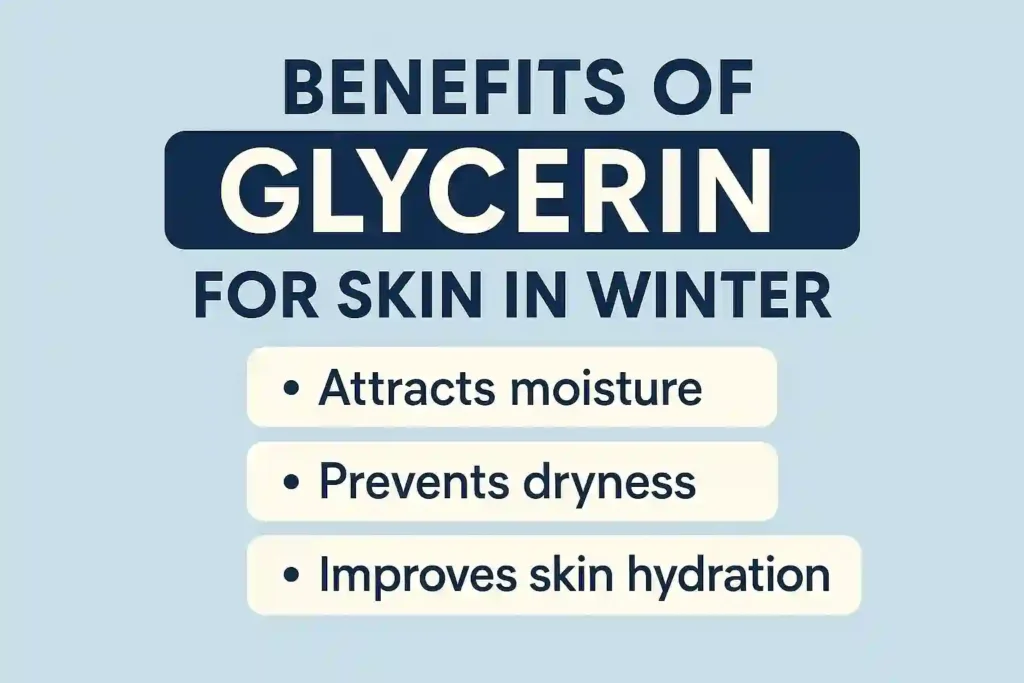
Glycerin is a component of your skin’s Natural Moisturizing Factor (NMF). It not only hydrates but also helps improve your skin barrier function. Best for all skin types, especially dry and sensitive.
Ceramides (Look for Ceramide NP, AP, or EOP)
Products containing at least 1-2% ceramides have been shown to strengthen the skin barrier, prevent transepidermal water loss (TEWL) etc.
Shea Butter
Deep nourishment, great for very dry skin.
Niacinamide (Vitamin B3)
The Soothing Superstar, It helps improve your skin barrier function, reduces redness and inflammation, and can even help regulate oil production. It’s a true multi-tasker.
A 2024 study published in Scientific Reports found that combining niacinamide with hyaluronic acid improved fine lines, wrinkles, luminosity, and smoothness after just two months of use. The combo even showed anti-aging effects at the cellular level!
Salicylic Acid (in low concentrations)
Salicylic acid helps prevent clogged pores, reduces acne, and controls oil production.
Aloe Vera Extract
Moisturizers Based on Skin Type
Now, let’s combine these ingredients into a perfect recipe for your skin type.
For Dry Skin:
Look for: ✅Hyaluronic acid
✅ceramides
✅shea butter
✅ glycerin……………..etc.
Dry skin lacks both oil + water  needs heavy moisturizers to lock hydration.
For Oily Skin:
Look for: ✅ Glycerin
✅ Niacinamide
✅ Hyaluronic acid
✅ Aloe vera……………..etc.
Oily skin still gets dehydrated in winter needs lightweight hydration.
Sensitive or Acne-Prone Skin
Avoid:
❌ Fragrance
❌ Mineral Oil
❌ Alcohol
❌ parabens
❌ SLS/SLES
Look for:
✅ Ceramides
✅ Centella Asiatica
✅ Panthenol
✅ Squalane
✅ Colloidal Oatmeal
✅ Fragrance-free formulas
Ingredients matter
As a common man, we have no alternative way to verify which product is harmful and which is not. Only the ingredient list can help us in this regard. There is no other way.
So, before buying anything, be sure to check the ingredients list
How to Read a Label
1. First 5 Ingredients Matter the Most
Because they make up 70–80% of the formula.
2. Look for ‘Fragrance-Free’ Not ‘Unscented’
Unscented sometimes has masking chemicals.
3. Prefer Dermatologically Tested / Non-comedogenic
4. Avoid “Fairness”, “Glow”, “Whitening” Words
These usually include bleaching agents or strong actives.
Is this article helpful?
The Bottom Line
Listen, I know this is a LOT of information. But here’s what I want you to remember:
✅ Avoid: Parabens, sulfates, synthetic fragrances, phthalates, PEG etc.
✅ Embrace: Hyaluronic acid, ceramides, niacinamide, glycerin, natural ingredients.
✅ Always: Read labels, patch test, and listen to your skin.
Your Action Plan Before You Buy
- Read the Label: Don’t just look at the marketing on the front. Turn it over and scan the first 5-7 ingredients—that’s what it’s mostly made of.
- Patch Test: Before slathering it all over your face, test a small amount on your inner arm or behind your ear for 24-48 hours.
Best in market
- Nat Habit Double Cocoa Moisturizers, Skin Malai, Body Cream, Body Butter, Cold Cream Winter | For Dry Skin
- Bare Necessities Rainforest Non-Sticky Daily Moisturizer for Men | Lightweight and Non Greasy | Soothing After Shave Lotion with Aloe Vera, For Dry Skin
- Santulan Ayurveda, Radha Face Oil, For Dry Skin
Q. Do I really need a moisturizer in winter even if I have oily skin?
Yes, you need a moisturizer in winter even with oily skin. Choose a lightweight, non-comedogenic moisturizer to maintain hydration without adding excess oil.
Q. How do I know if a moisturizer is safe for sensitive skin?
Check for labels indicating hypoallergenic, fragrance-free, and non-comedogenic. Look for simple ingredient lists with fewer potential irritants. Conduct a patch test before full application. Avoid products with alcohol, artificial dyes, and heavy fragrances.
Q. Which ingredients are best for dry skin in winter?
The most effective barrier-repair ingredients are:
Ceramides
Shea Butter
Glycerin
Hyaluronic Acid
These help lock in moisture and prevent winter dryness.
Q. Can moisturizers cause acne?
Moisturizers can cause acne if they are comedogenic, meaning they clog pores. Look for non-comedogenic products and test them on a small area first.

I’m Mehebub Alam Chowdhury, an M.Sc. Organic Chemistry student, and my mission with Decodepure is to simplify complex chemical ingredients in everyday products. With my knowledge of chemicals, I aim to help you make safer, healthier choices by breaking down product labels in an easy-to-understand way.