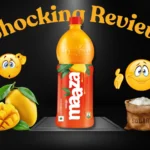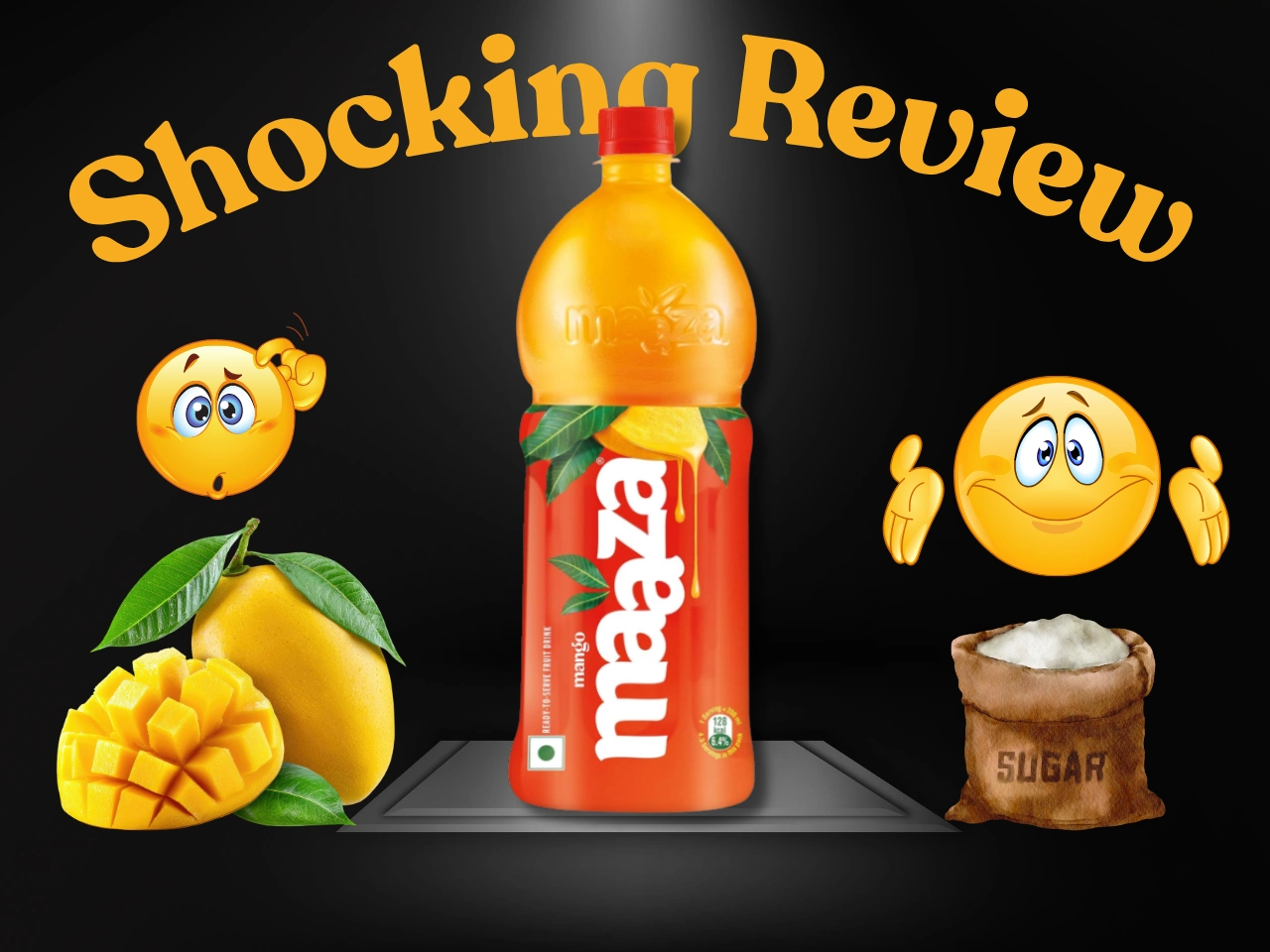
When I checked the ingredient list of Maaza carefully, honestly, it felt less like a “mango drink” and more like a chemistry experiment with mango flavour added at the end.
The front label shows juicy mangoes, thick texture, and refreshing summer vibes. But once you flip the bottle and read the back label, the story changes completely.
Table of Contents
Analysis
According to the label, the ingredients are:
- Water
- Mango Pulp (16.9%)
- Sugar
- Acidity Regulators (330, 331(iii))
- Antioxidant (300)
- Preservative (202)
- Colour (110)
- Added Mango Flavours (Natural, Nature-Identical & Artificial Flavouring Substances)
And the nutrition facts are even more shocking:
- 14g sugar per 100ml
- 13.2g added sugar per 100ml
- Around 28g sugar in one 200ml glass
That means just one glass gives more than half of the daily added sugar limit.
First Big Shock: It Contains Only 16.9% Mango Pulp
Look at the ingredients list. Mango pulp is listed at just 16.9%.
That means in every 100ml of Maaza, only about 17ml is actual mango. The rest, more than 83ml, is water, sugar, and chemicals.
Ingredient Breakdown
1. Water
This is the main ingredient, meaning most of the bottle is just water.
Nothing harmful here by itself, but it shows that consumers are paying premium prices for flavored sugar water with a small amount of mango pulp.
2. Mango Pulp (16.9%)
This is the only genuinely positive ingredient.
Real mango pulp contains:
- Small amounts of vitamin A
- Natural carotenoids
- Some antioxidants
But the amount is too low to make Maaza a “healthy fruit drink.” Once diluted with water and loaded with sugar, the nutritional value becomes minimal.
Sugar – The Real Main Ingredient
Look at the nutrition label on the back of any Maaza bottle.
Per 100ml → 13.2g of added sugar Per 200ml serving → 26.4g of added sugar. That means a 600ml bottle can easily contain around 80g+ sugar.
One tablespoon of sugar, approximately 4 g, so a 200ml bottle contains 6.6 tablespoons of sugar.
That is already MORE than the World Health Organization’s recommended daily limit of 25g of free sugars for an adult. And that’s just one small 200ml serving. Most people drink 250ml or even 600ml bottles in one go.
According to the WHO, excess sugar intake is linked with:
- Obesity
- Fatty liver
- Insulin resistance
- Type 2 diabetes
- Tooth decay
Scientific Reference:
World Health Organization – Sugar Guidelines
This is why these drinks feel “addictive.” The brain responds strongly to high sugar concentrations.
4. Acidity Regulator (INS 330) — Citric Acid
INS 330 is citric acid.
It’s commonly used to:
- Increase shelf life
- Control sourness
- Balance sweetness
Citric acid itself is generally considered safe in small amounts. But in acidic sugary drinks, frequent exposure may contribute to:
- Tooth enamel erosion
- Increased acidity load in the mouth
Scientific Reference:
NIH – Acidic Beverages and Dental Erosion
INS 331(iii) – Sodium Citrate
This ingredient helps stabilize acidity and improve taste consistency. Usually considered safe.
6. Antioxidant (INS 300) – Ascorbic Acid
This is basically Vitamin C. Sounds healthy, right?
But companies often use it mainly to:
- Prevent oxidation
- Maintain color
- Increase shelf life
The amount present is usually too low to make the drink nutritionally valuable.
7. Preservative (INS 202) – Potassium Sorbate
This ingredient prevents microbial growth and increases shelf life.
It is widely used in processed drinks. Regulatory agencies allow it within limits.
8. Colour (INS 110)
This is the ingredient that shocked me most too.
INS 110 = Sunset Yellow FCF
A synthetic artificial colour.
It is added mainly to make the drink look rich, bright, and mango-like.
Some studies and regulatory discussions have linked certain synthetic food colours with:
- Hyperactivity in sensitive children
- Allergic reactions
- Behavioral effects in susceptible individuals
Misleading
This is one of the most misleading parts. Companies intentionally keep flavour descriptions vague.
This phrase can include:
- Natural flavours
- Chemically synthesized flavours
- Artificial aroma compounds
Consumers never know the exact chemicals used because regulations allow broad labeling categories. Even food awareness platforms criticize this lack of transparency.
Is Maaza Actually Healthy?
Short answer: No.
It’s healthier than soda only in the sense that it contains some mango pulp.
But calling it a “healthy fruit drink” would be misleading.
The product is mainly:
- Water
- Sugar
- Flavours
- Additives
- Colouring agents
with a limited amount of real mango.
My Final Verdict on Maaza
Good Things
- Contains some real mango pulp
- Tastes good
- Convenient and widely available
Problems
- Extremely high added sugar
- Artificial colour (INS 110)
- Preservatives
- Artificial flavouring substances
- Very low actual mango content compared to consumer perception
Better Alternatives
If you genuinely want mango nutrition:
- Eat real mangoes
- Make homemade mango shake
- Blend mango with curd or milk
- Choose products with:
- No artificial colours
- No preservatives
- Higher fruit percentage
- Lower added sugar
Because the truth is:
Maaza sells the feeling of mango more than actual mango nutrition.
And once you read the ingredient list carefully, it becomes impossible to unsee it. Thank you so much 🫡.

I’m Mehebub Alam Chowdhury, an M.Sc. Organic Chemistry student, and my mission with Decodepure is to simplify complex chemical ingredients in everyday products. With my knowledge of chemicals, I aim to help you make safer, healthier choices by breaking down product labels in an easy-to-understand way.