There are many people who are health-conscious, and most of them prefer to eat jaggery (gur) as a “natural” replacement for white sugar. It’s unrefined, traditional, and often found in Indian kitchens.
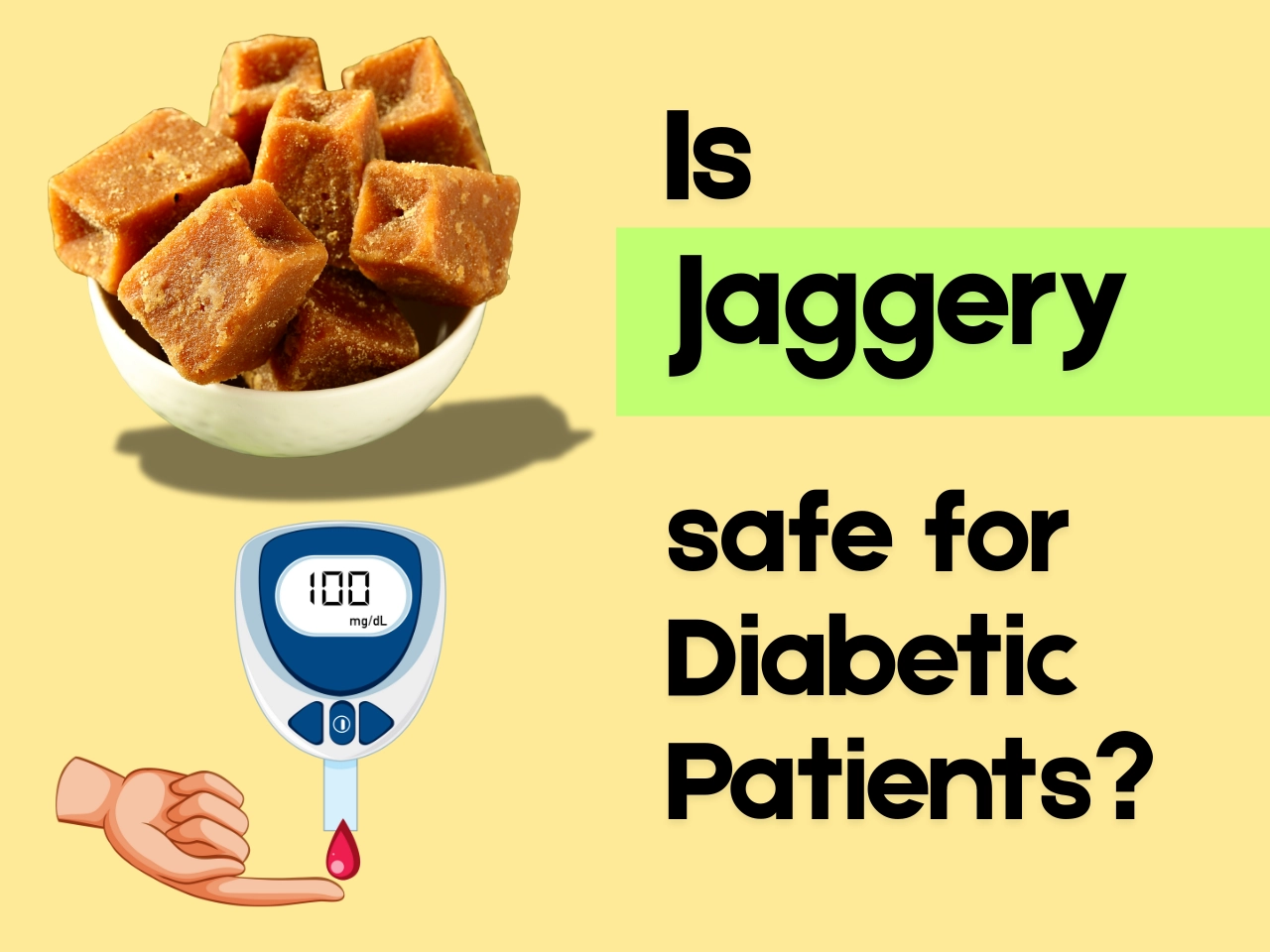
But here’s the big question: Is jaggery safe for diabetic patients? In this blog post, let’s decode the truth with science, logic, and real-life impact.
Table of Contents

What Exactly is Jaggery?
Before we dive into the debate, let’s understand what jaggery is. Often called “gur” in Hindi, it’s a traditional, unrefined sugar product. It’s made by boiling down sugarcane juice or palm sap until it solidifies. It’s known for its golden brown color, rich taste, and traditional health benefits.
The “Healthy” Hype: Why People Love Jaggery
During this process, minerals like iron, calcium, phosphorus, and magnesium are preserved, which are completely stripped away during white sugar production.
That sounds good, but wait before you start adding it to your everyday food items.
Nutritional Breakdown: Jaggery vs Sugar
| Nutrient (per 100g) | Jaggery | Sugar |
|---|---|---|
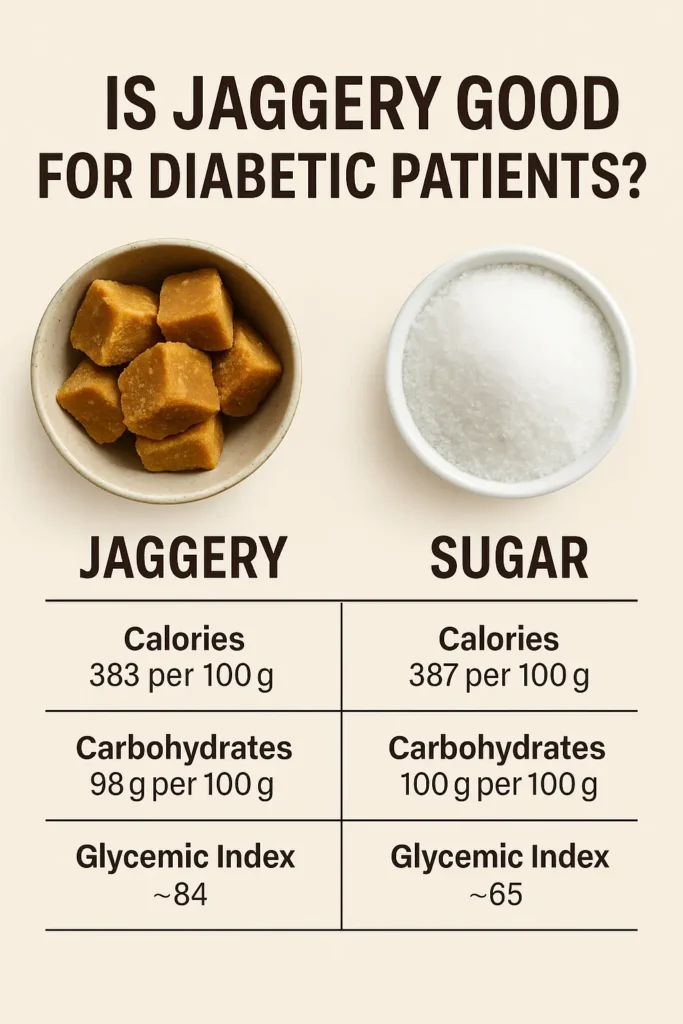
| Calories | 383 | 387 |
| Carbohydrates | 98g | 100g |
| Sugar (sucrose) | ~85g | 100g |
| Iron | ~11mg | 0mg |
| Fiber, Protein | Very low | None |
1. Calories
Jaggery: 383 kcal | Sugar: 387 kcal
Both jaggery and sugar are high in calories. If you’re trying to reduce weight loss or control blood sugar, jaggery offers no real calorie advantage.
2. Carbohydrates
Jaggery: 98 g | Sugar: 100 g
Both are almost pure carbohydrates, with only a slight 2 g difference. Not good for people with diabetes or insulin resistance, since they rapidly spike blood glucose levels.
3. Sugar (Sucrose)
Jaggery: ~85 g | Sugar: 100 g
In sugar, it’s 100% sucrose, highly refined.
In jaggery, sucrose is around 85%, with the remaining 15% being glucose, fructose, water, and trace minerals.
While jaggery has a lower sucrose content, it’s still a high-sugar product. The amount of carbohydrates and calories in a teaspoon of jaggery is very similar to that in a teaspoon of white sugar.
4. Iron
Jaggery: ~11mg | Sugar: 0mg
That’s about 61% of the daily iron requirement for men and 37% for women (based on RDA).
5. Fiber & Protein
Jaggery: Very Low | Sugar: None
Jaggery contains traces of fiber and protein from its plant-based origin, but the amounts are negligible.
So yes, jaggery has more nutrients, but it’s still very high in sugar and calories, nearly the same as white sugar.
Compare Glycemic Index (GI)
Let’s get to the main point. Here’s how jaggery compares:
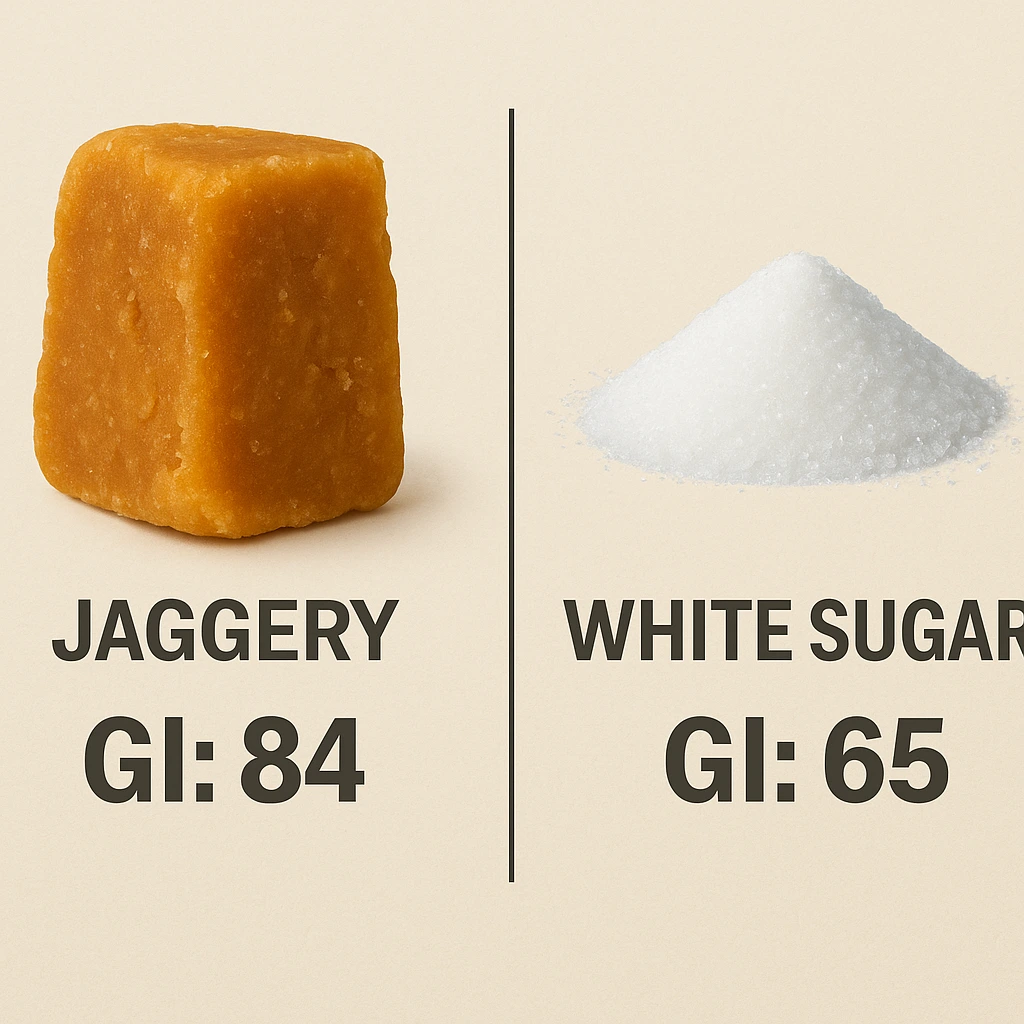
- Jaggery Glycemic Index (GI): ~84.1
- Sugar GI: ~65
Surprisingly, jaggery has a higher glycemic index than sugar!
That means it raises your blood sugar even faster than sugar. So, if you have diabetes or are a pre-diabetic patient, be aware.
Helpful link – (Harvard Medical School), University of Sydney
- Foods with GI below 55 are considered low-GI (good for diabetics)
- Foods with GI 55-70 are moderate-GI
- Foods with GI above 70 are high-GI (should be limited for diabetics)
Why Many Believe Jaggery is “Healthier”
1. It has minerals, so it’s healthy.
→ True, but the amount is very low. You’d need to eat a lot of jaggery to get any real iron or magnesium, and that comes with a sugar overload.
2. You can eat more jaggery than sugar because it’s healthier.
→ From a blood sugar perspective, jaggery may actually be worse than white sugar due to its higher glycemic index.
Is It a Good Decision to Switch to Jaggery from Sugar?
A lot of us switch to jaggery, thinking it’s the “healthier” alternative to sugar. And yes, it’s true that jaggery does have some minerals like iron and potassium. But it’s still sugar.
If you’re not diabetic and you want to replace sugar in a sweet dish with a more natural option once in a while, jaggery is okay. But don’t fall into the trap of thinking it’s some kind of healthy superfood—it’s not.
Diabetic patient—try to avoid it.
What Does Science Say?
1. A 2021 study published in Current Research in Nutrition and Food Science found that jaggery causes a similar glycemic response as sugar, making it unsuitable for diabetics.
2. Nutritionists from AIIMS Delhi confirm: “Jaggery is better than refined sugar in terms of nutrients, but it’s still not suitable for diabetics due to its high glycemic load.”
3. The American Diabetes Association (ADA) warns against all high-GI sweeteners—even natural ones—because they can lead to blood sugar spikes.
Better Sweet Alternatives for Diabetic Patients
| Sweetener | GI | Calories | Safe for Diabetes? |
|---|---|---|---|
| Stevia | 0 | 0 | ✅ Yes (natural, no impact on sugar) |
| Monk Fruit Extract | 0 | 0 | ✅ Yes |
| Erythritol | 0–5 | ~0 | ✅ Yes |
| Xylitol | ~13 | 2.4/g | ⚠️ In moderation |
| Coconut Sugar | ~54 | 375 | ⚠️ Still high in carbs |
Is this article helpful?
Final Verdict: Is Jaggery safe for Diabetic patients?

No, jaggery is not good for diabetic patients.
While it may be slightly “less bad” than white sugar due to trace minerals, it still causes rapid blood sugar spikes, making it unsafe for people with diabetes.
If you’re diabetic, switching to jaggery from sugar is like going from regular cola to fruit juice—it feels better, but your body still sees it as sugar.
If you really want to cut down on sugar, you’re better
Q. Can a diabetic eat a small amount of jaggery?
Diabetics should generally avoid jaggery due to its high sugar content, even in small amounts, as it can affect blood sugar levels. Always consult a healthcare professional for personalized advice.
Q. Does jaggery have a lower glycemic index than sugar?
Surprisingly, no. Jaggery actually has a higher glycemic index (~84–95) compared to sugar (~65), meaning it raises blood sugar even more quickly.
Q. Is jaggery better than sugar for diabetics?
Not really. Jaggery may have a few minerals, but it still spikes blood sugar — even faster than sugar. So, for diabetics, it’s not a safe alternative.
Q. What are healthier sugar alternatives for diabetics?
Some good options include stevia, monk fruit extract, erythritol, and xylitol (in moderation). These don’t spike blood sugar like jaggery or sugar.

I’m Mehebub Alam Chowdhury, an M.Sc. Organic Chemistry student, and my mission with Decodepure is to simplify complex chemical ingredients in everyday products. With my knowledge of chemicals, I aim to help you make safer, healthier choices by breaking down product labels in an easy-to-understand way.