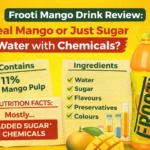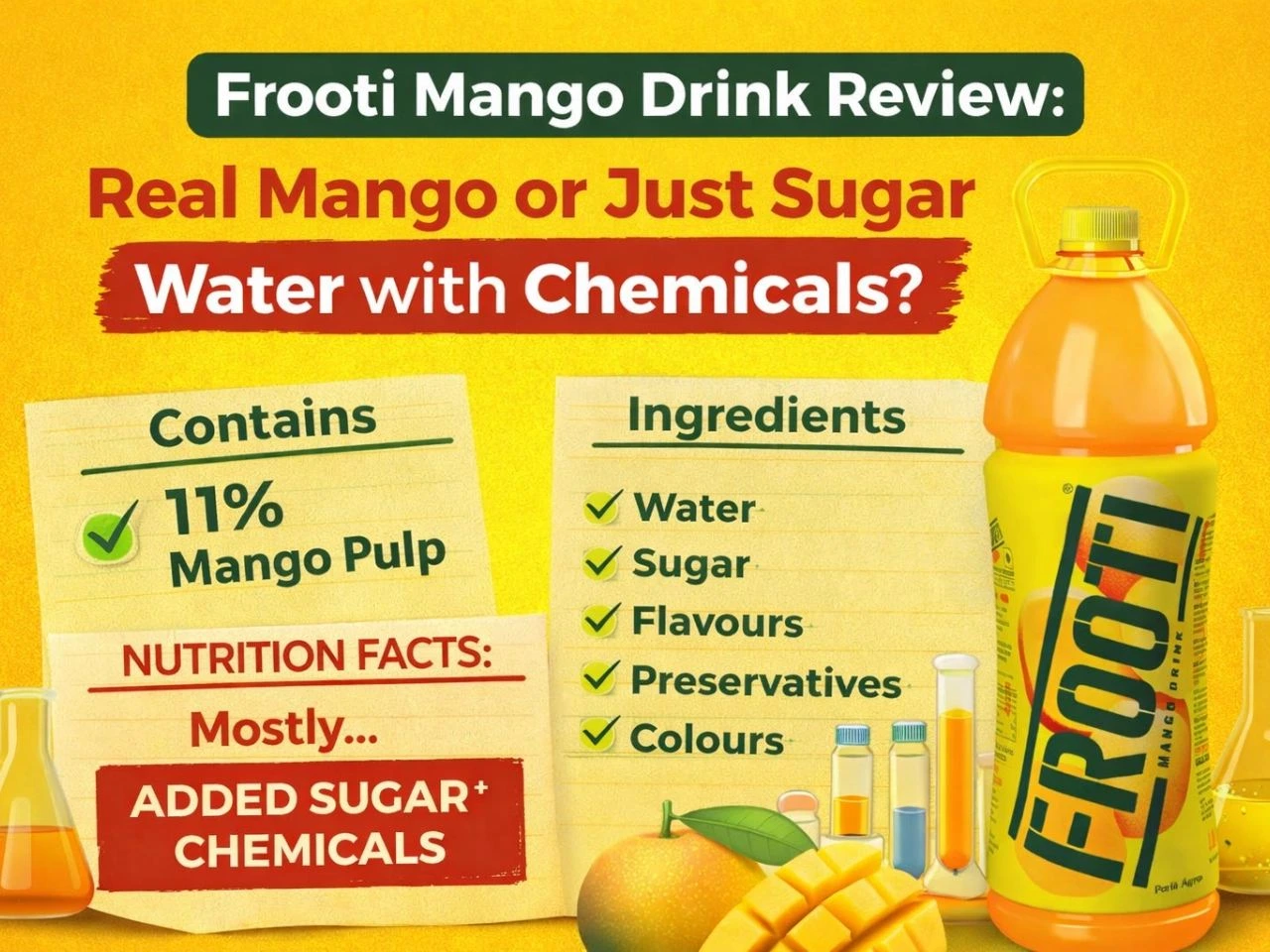
If you grew up in India, chances are you have drunk Frooti at least once. The bright yellow pack, the tagline “Fresh and Juicy”, and heavy celebrity marketing make it look like a refreshing mango drink made from real fruit.
But when I carefully read the Frooti ingredients label, honestly… the reality shocked me. Because what you are actually drinking is mostly water, sugar, and additives, with a small amount of mango pulp. Let’s decode the ingredients one by one.
Table of Contents
Ingredients List
According to the bottle I picked up, the full ingredient list is:
Water, Sugar, Mango Pulp (11.2%), Acidity Regulators [INS 330, INS 331(iii)], Nature-Identical Flavouring Substances (Mango), Stabilizers (INS 466, INS 415), Preservative (INS 211), Antioxidant (INS 300), Food Colour (INS 110), Antifoaming Agent (INS 900a)
First Reality Check: How Much Mango Is Actually Inside?
Mango Pulp (Only 11.2%)
Yes, you read that right. Just 11.2% mango in a “mango drink.”
That means in 100 ml of Frooti:
- Only about 11 ml is mango
- The rest 89 ml is mostly water, sugar, and additives
In other words, the drink is legally called a “fruit drink”, not fruit juice. That’s why the pack says “thermally processed, ready to serve fruit drink.” This category allows companies to add flavour, colour, preservatives, and stabilizers.
So that mango taste you love? A lot of it isn’t coming from real fruit. Keep reading to find out where it actually comes from.
Nutritional Reality: Mostly Sugar
From the nutrition label (per 100 ml):
- Total sugars: 15.6 g
- Added sugar: 14.2 g
This means almost 90% of the sugar is added sugar, not from mango.
200 ml pack contains ≈ 28 g of sugar. That’s around 7 teaspoons of sugar
Per 100ml 14.2g added sugar, means 200ml pack = 200 ×14.2 ≈ 28 g of sugar. One teaspoon of sugar is ≈ 4gm, So 28 ÷ 4 = 7 teaspoons of sugar
Regular intake of sugary drinks is associated with:
- obesity
- type-2 diabetes
- fatty liver
- heart disease
This is why WHO recommends limiting free sugar intake.
Ingredient Breakdown
Let’s decode other ingredients.
1. Water
This is the main ingredient.
Most fruit drinks are essentially sugar water with flavour.
Water is not harmful, but it explains why the actual fruit content is very low.
2. INS 330 & INS 331(iii): Acidity Regulators (Citric Acid & Sodium Citrate)
These two aren’t the scary ones on this list. Both INS 330 (citric acid) and INS 331 (sodium citrate) are generally recognized as safe (GRAS) by food safety authorities. (Tenger Chemical)
INS 330 – Citric Acid: Naturally found in citrus fruits.
Used to:
- improve flavour
- maintain acidity
- preserve drinks
INS 331 – Sodium Citrate: Generally considered safe in regulated amounts.
Used to:
- control pH
- stabilize beverages
3. Nature-Identical Flavouring Substances (Mango)
This one sounds fancy and wholesome, but let me decode it for you.
“Nature-identical” does NOT mean natural. It means the flavour molecule was recreated in a laboratory. It’s a synthetic flavour that smells and tastes like mango, but it has never been near a mango tree.
So, the mango taste may come more from flavour chemicals than from the real mango. The “fresh n juicy” aroma? Mostly a lab creation.
4. INS 466 & INS 415: Stabilizers (Carboxymethyl Cellulose & Xanthan Gum)
These are added to give the drink a smooth, consistent texture and prevent the drink from separating (no one wants to see mango chunks sitting at the bottom).
INS 415 (Xanthan Gum) is relatively harmless for most people. But INS 466 (Carboxymethyl Cellulose or CMC) is worth knowing about.
5. INS 211: Preservative (Sodium Benzoate)
⚠️Okay, this is where things get serious.
Sodium benzoate is widely used to prevent bacteria, yeast, and mold growth in acidic drinks.
Sodium Benzoate is one of the most controversial food preservatives in the world. It has been linked to attention deficit hyperactivity disorder (ADHD) in children.
- When Sodium Benzoate is combined with vitamin C, it can form benzene, a compound linked to cancer under certain conditions.
- Some studies suggest it may increase hyperactivity in children when combined with artificial colours
References:
- Wenmd – What You Should Know about Sodium Benzoate
- Elchemy – Is Sodium Benzoate Bad? What Food Manufacturers Need to Know About Preservative Safety
6. Antioxidant
INS 300 – Ascorbic Acid
This is Vitamin C. This one’s actually the good guy on the list. INS 300 is simply Vitamin C (ascorbic acid), which helps prevent the drink from oxidising and going stale. It’s safe and beneficial.
7. Food Colour
NS 110: Food Colour (Sunset Yellow FCF)
This is a synthetic azo dye used to make the drink look bright orange. INS 110, also known as Sunset Yellow FCF, is a petroleum-derived synthetic dye. It is derived from petroleum and is known internationally as FD&C Yellow 6 in the US and E110 in Europe.
Concerns associated with some artificial colours include:
- allergic reactions
- hyperactivity in children
- intolerance in sensitive individuals
8. Antifoaming Agent
INS 900a: Antifoaming Agent (Polydimethylsiloxane)
This is added to prevent the drink from foaming during manufacturing. It’s a silicone-based compound and is considered safe at the small quantities used in food. Not the scariest thing on this list.
Is this article helpful?
Final Verdict: Is Frooti Healthy?
Let’s summarize the reality.
What you think you are drinking
- Fresh mango drink
- Natural fruit refreshment
What it actually is
- Mostly water
- Large amount of added sugar
- Only 11% mango
- Multiple additives and preservatives
So calling it a “mango drink” is technically correct, but nutritionally misleading.
The Final Word
Frooti is not evil. It’s a legal product that follows Indian food safety rules. But “legal” and “healthy” are not the same thing. As consumers, we have the right to know what’s in our food and the right to make better choices for ourselves and our families.
You deserve to know what you are putting on your body. I believe that buying anything shouldn’t be a guessing game. My mission is to encourage people to make smarter, safer choices by decoding each ingredient.
Because the most powerful thing you can do for your health is to simply know what you’re drinking.
Next time, before buying anything, you must read the ingredients list 💖

I’m Mehebub Alam Chowdhury, an M.Sc. Organic Chemistry student, and my mission with Decodepure is to simplify complex chemical ingredients in everyday products. With my knowledge of chemicals, I aim to help you make safer, healthier choices by breaking down product labels in an easy-to-understand way.