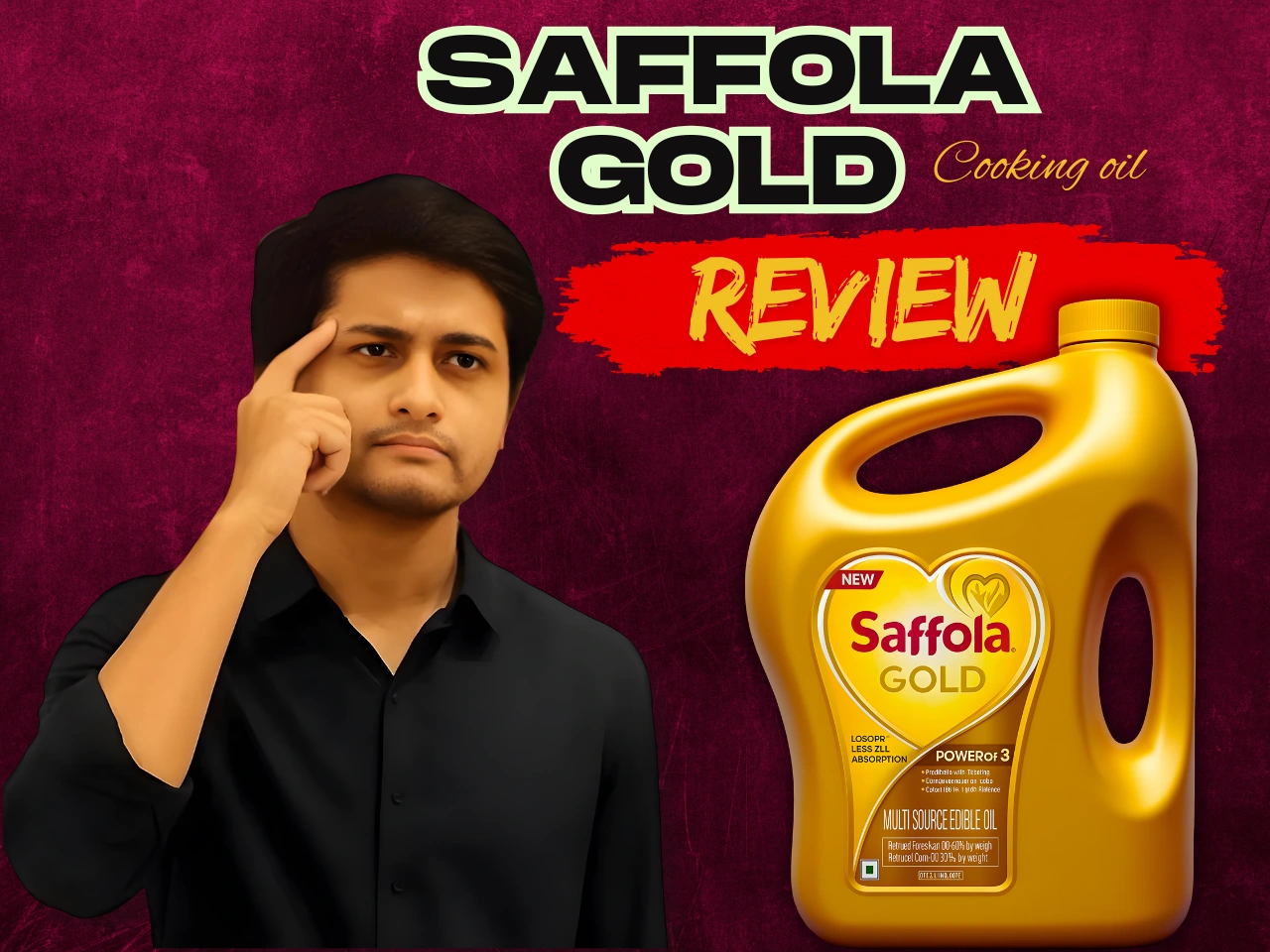
‘Saffola Gold cooking oil’ is one of the most popular cooking oils in Indian households. Saffola Gold is marketed as a heart-healthy, low-absorption oil with a “Power of 3” promise—fortified vitamins, an antioxidant system, and a good fat balance, making it easy to assume that it is a healthier option.
But is it really?
Let’s decode what’s inside the yellow bottle—ingredient by ingredient—and figure out if it truly deserves a spot in your kitchen.
Table of Contents
Ingredients Analysis
According to the label,
- 80% Physically Refined Rice Bran Oil
- 20% Refined Corn Oil
- Antioxidants (INS 319, INS 330)
- Vitamins (A, D, E)
- Anti-Foaming Agent (INS 900a)
Refined oil
Before explaining the ingredients properly, it is important to first know what the term refined oil means.
Seeds such as soybean, sunflower, canola, and cottonseed are crushed and mixed with solvent (e.g., hexane) to extract the oil. Chemical solvents (like caustic soda or hexane) are used to remove impurities and free fatty acids (FFA).
After that, the oil is heated to 230–260°C in a vacuum. This high heat destroys beneficial nutrients, like vitamin E, and forms trans fat. Preservatives like TBHQ are used to extend shelf life.
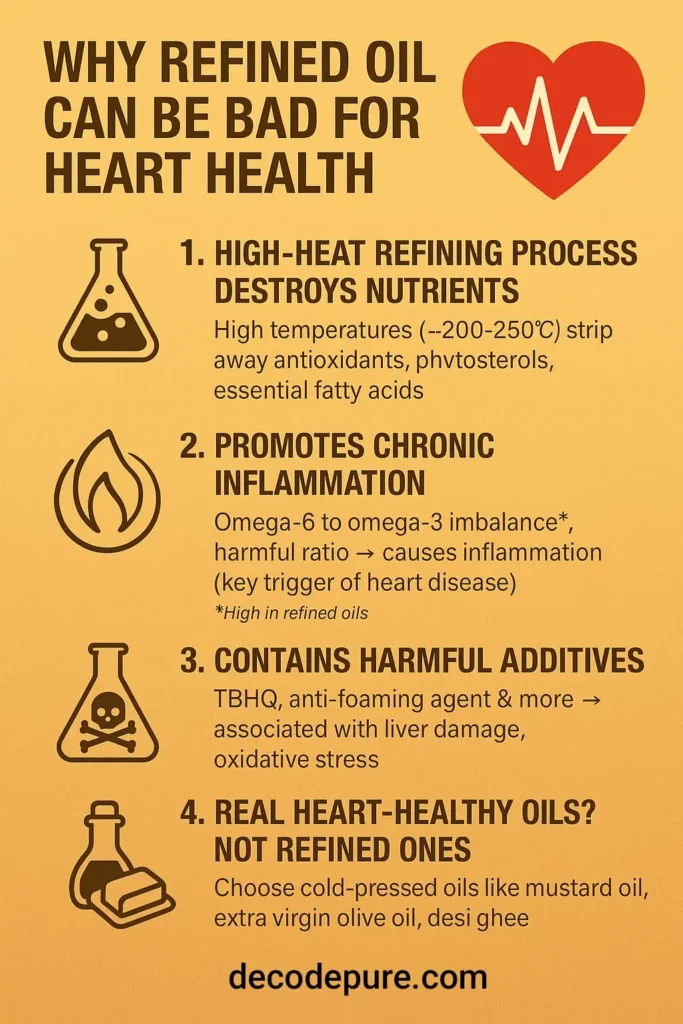
Health concerns
1. Most nutrients, vitamins (such as E and K), and antioxidants are removed. This oil loses its protective benefits and becomes “empty calories” (Gunstone FD, Vegetable Oils in Food Technology, 2002).
2. High-heat processing creates trans fats and free radicals, which are associated with increasing LDL (bad cholesterol) and raising the risk of heart disease, stroke, and chronic inflammation. (Harvard T.H. Chan School of Public Health)
3. Hexane residues may remain in trace amounts. It’s a neurotoxin linked to nervous system disorders.
4. Preservatives like TBHQ and BHA are associated with liver enlargement, tumors, and DNA damage. (NIH National Toxicology Program)
5. Refined oils like soybean, sunflower, and corn oil are high in omega-6. Linked to heart disease, diabetes, etc.
6. When refined oils are heated (during refining and cooking), they produce aldehydes, acrolein, and trans fats (in small but harmful amounts). Aldehydes are cytotoxic, mutagenic, and carcinogenic.
1. Physically Refined Rice Bran Oil (80%)
Rice bran oil is extracted from the hard outer layer of rice grains. It’s known for a compound called oryzanol, which may help reduce cholesterol levels.
Rice bran oil is high in unsaturated fats (MUFA + PUFA) and has a high smoke point (ideal for Indian cooking). But the word “refined oil” makes it unhealthy.
What Does “Physically Refined” Mean?
“Physically refined” means the oil is refined using steam instead of chemicals, but it still involves high heat that destroys nutrients. It may be slightly better than chemically refined oil, but it’s still not healthy like cold-pressed oils.
2. Refined Corn Oil (20%)
Corn oil is mostly polyunsaturated fat, mainly omega-6 fatty acids. While omega-6 is essential and good for our health, too much of it without omega-3 balance is a concern.
In this case, also, “refined oil”—this word makes it unhealthy.
Refined oils like sunflower, corn, safflower, rice bran, and soybean are extremely high in omega-6 fatty acids and very low in omega-3s.
Ideal Omega-6: Omega-3 ratio = 4:1 or 2:1
Refined oils = 20:1 to 70:1
This imbalance promotes chronic inflammation, which is a root cause of
- Heart disease
- Obesity
- Diabetes
- Cancer
- Arthritis
If you want to know more about ‘Omega-3’ and ‘Omega-6,’ click here.
3. Antioxidants (INS 319 & INS 330)
INS 319 (tertiary butylhydroquinone or TBHQ) is one type of preservative used to increase the shelf life of oil. Regular intake can affect liver function.
INS 330 (citric acid), a natural acid used as a preservative and antioxidant. Generally Recognized as Safe (GRAS) when used within limits.
Preservatives will extend the life of oil but shorten our lives.
4. Vitamins (A, D, E)
These vitamins are added to enhance the “nutritional value.” Vitamin E, a natural antioxidant, protects cells.
5. Anti-Foaming Agent (INS 900a – Dimethylpolysiloxane)
The anti-foaming agent is a chemical that prevents excessive foaming during frying. Common in oils and fast foods. Safe in very small quantities as per the food safety authorities.
Nutritional Summary (Per 100g):
- Total Fat: 100g
- Saturated Fat: 22g
- Monounsaturated Fat: 42g
- Polyunsaturated Fat: 36g
- Omega-3: 0.6 g (very low)
- Omega-6: 35g (very high)
Problem: The omega-6 to omega-3 ratio is nearly 58:1. Ideally, it should be around 4:1 or 2:1 for a healthy anti-inflammatory diet.

Reference: PubMed, Harvard T.H. Chan School of Public Health – Cooking Oils Explained
Common Indian Cooking Oils Omega Ratio
| Oil | Omega-6 : Omega-3 Ratio |
|---|---|
| Sunflower oil | ~70:1 |
| Rice bran oil | ~30:1 |
| Soybean oil | ~7:1 |
| Mustard oil (cold-pressed) | ~1.7:1 ✅ |
| Groundnut oil | ~50:1 |
| Coconut oil | Very low PUFA (almost no omega-6 or 3) |
Download free Pdf
Is this article helpful?
Summary
- Refined Oil—very bad.
- Extremely high omega-6 content → promotes inflammation if not balanced.
- Very low omega-3 content.
- Contains synthetic additives (TBHQ, anti-foaming agent)
- The omega-6 to omega-3 ratio is nearly 58:1, very bad (ideal ratio 4:1 or lower).
- Ultra-processed oil—not good for heart health.
- Physically refined (better than chemical refining).
- Contains oryzanol, good for heart health.
- Fortified with vitamins—good sign.
Summary Table
| Issue | Cause | Health Effect |
|---|---|---|
| Nutrient Loss | High heat refining | No antioxidants, no protection against oxidative stress |
| Aldehydes | High-heat cooking with refined oils | Inflammation, neurotoxicity, cancer |
| Omega-6 Overload | PUFA imbalance | Chronic inflammation, heart risk |
| Chemical Additives | TBHQ, INS 900a | Liver stress, hormone disruption |
| Trans Fat Formation | Repeated frying | Artery blockage, cholesterol issues |
Final Verdict

After discussing everything above, I believe it’s now crystal clear how harmful refined oil can be to your health. So, avoiding it is the smarter choice.
simple rule:
❌ If it says “refined oil” on the label, → avoid it.
✅ If it says “cold-pressed,” “wood-pressed,” or “virgin,” → safer & healthier
Q. Is Saffola Gold oil really healthy for daily use?
Saffola Gold is marketed as heart-healthy, but it is a refined oil with a very high omega-6 content and low omega-3s, which can promote inflammation when used daily. It also contains synthetic additives like TBHQ, making it less ideal for long-term health.
Q. What does “physically refined” oil mean? Is it better than normal refined oil?
“Physically refined” means the oil is refined using steam instead of chemicals, but it still involves high heat that destroys nutrients. It may be slightly better than chemically refined oil, but it’s still not healthy like cold-pressed oils.
Q. What are the side effects of using refined oils daily?
Daily use of refined oil can lead to:
Chronic inflammation
Heart problems
Hormonal imbalance
Liver stress
Increased risk of obesity, diabetes, and cancer
Q. Which oils should I use for cooking instead of refined oils?
Go for traditional, less processed oils:
Cold-pressed mustard oil
Wood-pressed groundnut oil
Virgin coconut oil
Desi ghee
Extra virgin olive oil (for raw use)
Q. Which oil is better: Saffola Gold or mustard oil?
Cold-pressed mustard oil is far healthier. It has a natural omega-6 to omega-3 ratio (~1.7:1), and is less processed. Saffola Gold is highly refined, low in omega-3s, and contains additives.
Q. Is Saffola Gold safe for kids and pregnant women?
Since it’s a refined oil with additives, it’s better to avoid for children and pregnant women. Use ghee, coconut oil, or cold-pressed oils instead — they are more natural and nutrient-rich.

I’m Mehebub Alam Chowdhury, an M.Sc. Organic Chemistry student, and my mission with Decodepure is to simplify complex chemical ingredients in everyday products. With my knowledge of chemicals, I aim to help you make safer, healthier choices by breaking down product labels in an easy-to-understand way.







Love it ❤️
Thank you 💕